SOC 2 Type 1 vs Type 2 for Indian Companies: Which to Get First
SOC 2 Type 1 vs Type 2 for Indian companies: point in time vs observation period, 3 to 12 month windows, cost, timeline and which report to get first.
14 min readBy Sachin Shirish, Director
Reviewed by Pragya Dwivedi, Associate Director, CISM, eWPTX
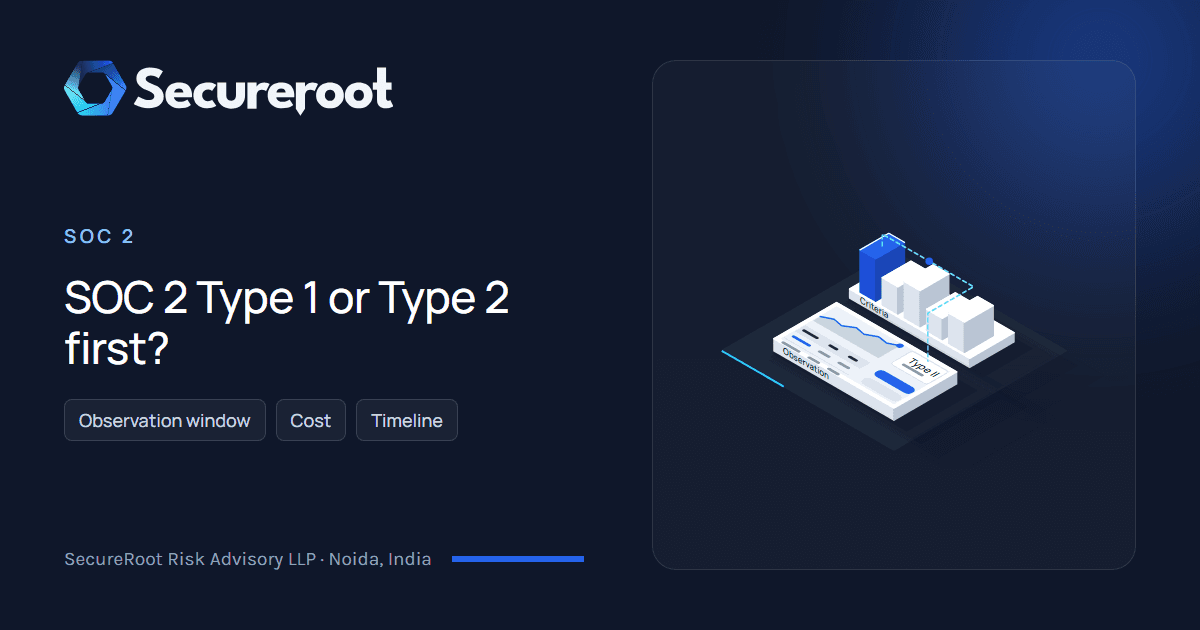
A SOC 2 Type 1 report tests whether your controls were suitably designed and in place on a single date. A Type 2 report tests whether those same controls operated effectively across an observation period, usually three to twelve months. Most Indian companies reach a Type 1 in eight to twelve weeks and a first Type 2 in six to nine months. Get Type 1 first if a deal needs proof this quarter; go straight to Type 2 if your buyers accept nothing else.
Type 1 and Type 2 at a glance
Both reports are examinations against the same criteria. The AICPA Trust Services Criteria cover security, availability, processing integrity, confidentiality and privacy. The difference is the question the auditor answers and the evidence needed to answer it.
| SOC 2 Type 1 | SOC 2 Type 2 | |
|---|---|---|
| Question answered | Were controls suitably designed and in place on a specific date? | Did controls operate effectively across an observation period? |
| Evidence the auditor tests | Design, configurations, policies, proof that each control exists | Samples drawn from across the whole window: access reviews, change tickets, incidents, backups, joiner and leaver records |
| Observation window | None; the report is as of one date | Usually 3 to 12 months; first reports commonly 3 to 6 |
| Typical time to report in India | Eight to twelve weeks from a standing start | Six to nine months for a first report |
| Indicative audit fee in India | Rs 2,00,000 to Rs 5,00,000 | Rs 5,00,000 to Rs 12,00,000 |
| How buyers weigh it | Evidence of intent and design | Evidence of controls working as a habit |
| Who issues it | A licensed CPA firm | A licensed CPA firm |
The fee ranges are indicative market figures for the CPA firm's audit fee, and they move with scope. The breakdown sits in our SOC 2 certification cost guide.
What a Type 1 report actually attests
A Type 1 report is a snapshot. The service auditor reviews your description of the system and checks whether the controls you describe were suitably designed to meet the criteria you put in scope, and whether they existed on the report date.
In practice, the auditor walks through your policies, inspects configurations in your cloud console and identity provider, and confirms each control is there: enforced MFA, a change procedure, a configured backup job. Nobody asks whether last quarter's access review happened, only whether it is designed properly and set up to run.
That makes a Type 1 faster and cheaper, and limits what it tells a buyer. A control that exists on the report date may never have run before it. Experienced security reviewers read a Type 1 as a statement of design, not proof of operation.
What a Type 2 report actually attests
A Type 2 report covers a period. The auditor still assesses design, then tests whether each control operated effectively throughout the observation window. The AICPA's illustrative SOC 2 Type 2 report shows the structure. It contains management's assertion, the description of the system, the service auditor's report, and the tests of controls with their results.
That last section is what buyers read. If your access review ran in April but was skipped in July, the report says so, as an exception alongside management's response. This is why a Type 2 carries more weight, and why it takes longer and costs more: the auditor needs evidence from every cycle of every recurring control.
Point in time vs observation period: how the window works
The observation window is the stretch of time a Type 2 report covers. The window only starts once your controls are designed and running. Evidence from before the start date does not count, and you cannot backfill it.
On our SOC 2 service, windows usually run from three to twelve months. A first report commonly uses a three to six month window. Annual reports after that usually cover a full twelve months, so each report starts where the last one ended and a customer never finds a gap to ask about.
Picking the window length is a trade-off:
- Three months gets a report to buyers fastest and suits a first Type 2.
- Six months gives quarterly controls two cycles of evidence.
- Twelve months is what mature programmes and cautious enterprise buyers expect, and lets annual controls show a full cycle.
A longer window means more samples per control, one of the main reasons Type 2 fees vary so widely.
Which report should an Indian company get first?
It depends on who is asking for the report and when. Four situations cover most Indian vendors.
Get Type 1 first if a deal needs proof this quarter
If a named deal is stuck in security review and the buyer will accept a Type 1 for now, start there. It gets an attestation into the buyer's hands in weeks while the Type 2 window runs. Treat it as a step towards Type 2; most buyers who accept one ask for a Type 2 at renewal.
Go straight to Type 2 if your buyers only accept Type 2
If your buyers say they want a Type 2, a Type 1 costs money without clearing the gate. Put the budget into readiness and open a three-month first window as soon as controls are running.
Get Type 1 first if your controls are still young
If you have never run formal access reviews or change approvals, a Type 1 forces the design work and surfaces gaps before they become Type 2 exceptions. A readiness assessment does much of the same job before any auditor is engaged, so weigh the two.
Skip Type 1 if you already run a certified ISMS
If you already hold ISO/IEC 27001 certification, most SOC 2 controls already run and produce evidence; the overlap is covered in our ISO 27001 vs SOC 2 comparison. A Type 1 adds little, and going straight to a Type 2 window is usually the better use of time.
Cost and timeline differences
The fee gap follows the work. A Type 1 audit is a design review with a fixed endpoint. A Type 2 audit repeats sampling across the window, and the fieldwork happens after the window closes. For Indian companies, indicative CPA audit fees are Rs 2,00,000 to Rs 5,00,000 for a Type 1 and Rs 5,00,000 to Rs 12,00,000 for a Type 2. Scope, the number of Trust Services Criteria categories, the number of systems and locations, and window length all move the figure. Our SOC 2 certification cost guide sets out what the fee does and does not include.
Readiness work, tooling, penetration testing and internal hours sit on top of the audit fee.
On timeline, a typical first-time path looks like this:
| Phase | Type 1 path | Type 2 path |
|---|---|---|
| Scoping, gap assessment and remediation | Most of the eight to twelve weeks | Same work, before the window opens |
| Observation window | Not applicable | 3 to 12 months (first report often 3) |
| Auditor fieldwork and report | A few weeks | A few weeks after the window closes |
| Typical total, first report | Eight to twelve weeks | Six to nine months |
The Type 2 total is almost entirely the window plus preparation. A Type 1 does not shorten the window. If you do a Type 1 first, the fastest route is to open the Type 2 window on or near the Type 1 report date, so both run from the same set of working controls. Our guide to SOC 2 services in India walks through the phases in more detail.
Only a licensed CPA firm issues the report
SOC 2 is part of the AICPA's System and Organization Controls suite, which the AICPA describes as services that CPAs may provide. The examination is performed under the AICPA attestation standards, and the AICPA's SOC 2 guide is the reference practitioners work from.
Three consequences matter when you plan:
- A consultant cannot issue your report. Readiness firms, compliance platforms and advisors, including SecureRoot, help you design controls and prepare evidence. The report itself comes from a licensed CPA firm that you contract with directly.
- Keep preparation and audit separate. Plan on one firm helping you build the controls and a different CPA firm auditing them. The auditor's opinion is only worth something to buyers if the auditor is independent of the people who built what it tests.
- "SOC 2 certified" is loose language. SOC 2 is an attestation report, not a certificate. A buyer receives the auditor's opinion and, for a Type 2, the tests and results. Unlike SOC 2, the AICPA describes SOC 3 as a general use report that can be freely distributed, because it leaves out the detail. In market practice, companies usually share a SOC 2 report with customers and prospects under an NDA.
When you shortlist auditors, confirm the signing firm is a licensed CPA firm, and book it before your window opens.
What stretches the timeline, and what shortens it
What stretches it:
- Controls that exist on paper but have not run a cycle when the window opens.
- Evidence scattered across email and spreadsheets with no owner.
- Scope creep, such as adding criteria categories or systems late.
- Engaging the CPA firm after the window closes.
What shortens it:
- A tight first scope: Security only, production systems only.
- A readiness assessment before any auditor is engaged.
- Evidence collection wired into existing tools, with named owners.
- A three-month first window, lengthened in the next cycle.
Where SecureRoot fits
SecureRoot does not issue SOC 2 reports itself; the report is issued by one of our partner CPA firms. We handle the work before and around the audit. That covers scoping the system description, running the readiness assessment, designing and implementing controls against the Trust Services Criteria, and preparing evidence through the observation window. When fieldwork starts, we support the auditor's requests. The report comes from an independent, licensed partner CPA firm that you engage directly. SecureRoot holds ISO/IEC 27001:2022 and ISO 9001:2015 certification, so our own delivery runs on the same kind of management system we help clients build. Scope and approach are described on our SOC 2 compliance service.
Frequently asked questions
What is the difference between SOC 2 Type 1 and Type 2?
A SOC 2 Type 1 report gives a service auditor's opinion on whether your controls were suitably designed and in place on one specific date. A Type 2 report covers that design opinion too, then adds testing of whether the controls operated effectively across an observation period, usually three to twelve months. For a Type 1, the auditor inspects policies and configurations and confirms each control exists. For a Type 2, the auditor samples evidence from the whole window: access reviews from each cycle, change tickets, incident records, backup logs, and joiner and leaver trails. It then reports the tests performed and any exceptions found. Both reports are measured against the AICPA Trust Services Criteria and both are issued by a licensed CPA firm. Buyers read a Type 1 as evidence that your controls are designed properly. They read a Type 2 as evidence that those controls work consistently over time, which is why enterprise procurement usually prefers it.
How long is the SOC 2 Type 2 observation period?
A SOC 2 Type 2 observation period usually runs from three to twelve months. A first Type 2 report commonly uses a three to six month window. That is long enough to show recurring controls operating, and short enough to get a report to buyers within the year. After the first report, most companies move to twelve-month windows that run back to back, so each annual report starts where the previous one ended and a customer never sees a gap in coverage. The window can only start once controls are designed and running, and evidence from before the start date does not count. A longer window adds samples per control, which raises the audit effort and fee. It also gives cautious buyers more confidence, and it lets annual controls such as risk assessments and continuity tests show a full cycle. Agree the window dates with your CPA firm before it opens.
Should an Indian startup get SOC 2 Type 1 or Type 2 first?
Start with the buyer. If a specific deal needs proof this quarter and the buyer will accept a Type 1, get the Type 1 first, then open the Type 2 window on or near the Type 1 report date. That puts an attestation in the buyer's hands within weeks while longer-term evidence builds. If your target buyers, often US or European enterprises, say they accept only a Type 2, skip the Type 1 and put that budget into readiness and a three-month first window. A Type 1 also helps when your controls are young, because it forces the design work and exposes gaps before they turn into Type 2 exceptions. If you already hold ISO/IEC 27001 certification, most controls are already running, so going straight to Type 2 is usually the better use of time and money. Either way, confirm in writing which report type your key customers require before you commit.
How much more does SOC 2 Type 2 cost than Type 1 in India?
Indicative market ranges for the CPA firm's audit fee in India are Rs 2,00,000 to Rs 5,00,000 for a SOC 2 Type 1 report and Rs 5,00,000 to Rs 12,00,000 for a Type 2. The gap reflects the work involved. A Type 1 auditor reviews design and confirms controls exist on one date. A Type 2 auditor samples evidence across the whole observation window and tests every cycle of every recurring control. A longer window adds samples and moves the fee again. Scope has the same effect: more Trust Services Criteria categories, more in-scope systems and more locations all mean more testing. The audit fee is also not the full cost. Readiness support, penetration testing, any compliance automation tooling and your team's time producing evidence sit on top. For a Type 2, that internal time is spread across the window rather than bunched before a single audit date, which is easier on a small team.
Can a SOC 2 consultant issue the SOC 2 report?
No. A SOC 2 report can only be issued by a licensed CPA firm working under the AICPA attestation standards. SOC 2 belongs to the AICPA's System and Organization Controls suite, which the AICPA describes as services that CPAs may provide. Plan on the firm that builds your controls and the firm that signs your report being different, because an auditor's opinion only carries weight if it is independent of the work it tests. Consultants, compliance platforms and advisory firms prepare you for the examination. They scope the system description, run the readiness assessment, fix design gaps, and organise evidence through the observation window. You then contract directly with a separate CPA firm for the audit itself. When a provider offers SOC 2 certification as a single package, ask who will sign the report and check that the signing firm is a licensed CPA firm. Remember too that SOC 2 is an attestation report, not a certificate.
Next step
If you are deciding between a Type 1 and a Type 2, or planning your first observation window, book a 30 minute scoping call. We will come back with a written scope, a timeline for the report type your buyers need, and a fixed price for the readiness work. The CPA firm's audit fee is quoted separately by the firm you engage.
Have a Question About This?
If this raised something specific to your environment, a scoping call is the fastest way to get a direct answer.
We reply within one business day.