
Secureroot's Attack Surface Management India Services continuously discovers, monitors, and prioritises your entire internet-facing footprint - known assets, forgotten assets, shadow IT, M&A inheritance, cloud sprawl, third-party exposures, and brand impersonations. We give you the attacker's view of your organisation, then help you close exposures before attackers find them. ISO 27001 certified team. CERT-In aligned.
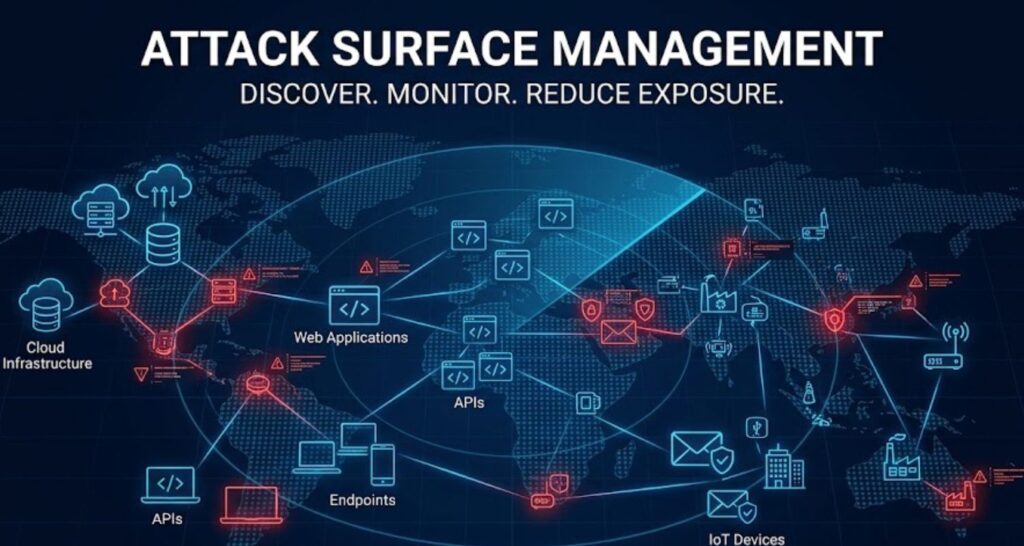
SecureRoot’s attack surface management in India continuously discovers and monitors your internet-facing assets – including the forgotten and shadow ones – so nothing exposed goes unnoticed.
Attack surface management in India continuously discovers, inventories and monitors every internet-facing asset your organization exposes - including the ones you Read More ...
have forgotten. Shadow IT, abandoned subdomains, exposed cloud storage, forgotten dev servers and third-party assets are where breaches often begin, precisely because no one is watching them. ASM maps your external footprint from an attacker's perspective, flags exposures and misconfigurations, and prioritises them by risk. SecureRoot combines continuous discovery with expert validation to cut false positives, alerting you to new or changed exposures as they appear. Unlike a one-time scan, it keeps pace with a footprint that changes daily. Ideal for organizations with cloud estates, acquisitions or a large digital presence. Delivered as a one-off assessment or an ongoing managed service, depending on your needs.
Our external attack surface management finds what your asset inventory misses – the subdomain a team spun up and forgot, the storage bucket left public, the exposed admin panel. You cannot protect what you cannot see, and ASM makes the invisible visible.
Provided as ASM services, our programme continuously watches for new exposures and changes, so a risky asset is flagged the day it appears rather than the day it is breached. Every alert is validated by an analyst, and pairs naturally with dark web monitoring for complete external visibility.
Pair external visibility with dark web monitoring and our managed cybersecurity services.















Our Attack Surface Management India provide the continuous discovery, inventory, classification, and monitoring of every internet-facing asset belonging to your organisation – and the exposures, vulnerabilities, and risks associated with each. Traditional security models focus on protecting KNOWN assets you’ve consciously deployed. ASM addresses the harder problem: discovering UNKNOWN assets that attackers can find but you’ve forgotten about. Forgotten dev environments, orphaned cloud resources from departed employees, subdomains from old products, M&A inheritances, shadow IT, third-party vendor exposures.
EASM (External Attack Surface Management) discovers assets visible from the internet – the attacker’s view. CAASM (Cyber Asset Attack Surface Management) inventories internal IT assets using authenticated access to your tools (cloud APIs, EDR, asset databases). EASM finds shadow IT and forgotten assets you might never have known existed. CAASM provides unified asset inventory across your known IT estate.
Our service primarily focuses on EASM – discovering and managing your external footprint – with CAASM integration for organisations with mature internal asset management.
Three forces make Attack Surface Management Services mandatory. Cloud sprawl: every developer with cloud access can provision public-facing resources in minutes – and forget about them.
Average organisations now have 30-50% more public assets than IT teams know about. M&A activity: every acquisition brings inherited attack surface – often unprotected. Shadow IT: SaaS subscriptions, marketing tools, contractor systems exist outside IT visibility. Combined: most organisations have 40-60% more attack surface than they think. Attackers actively use Attack surface management services like reconnaissance against you.

Aligned with Gartner CTEM (Continuous Threat Exposure Management) framework, NIST CSF asset management functions, and modern attacker reconnaissance methodology. Every ASM engagement runs through these six continuous phases.

We establish your discovery seeds: known domains, IP ranges, brand names, organisation identifiers, executive names, subsidiary structures, M&A history, third-party vendor relationships.
Output: scoping document defining what’s in-scope for ongoing ASM, exclusions, sensitive subsidiaries requiring discretion.

Multi-source discovery using OSINT techniques attackers actually use: subdomain enumeration (DNS, certificate transparency logs, search engines), cloud asset discovery (AWS/Azure/GCP public resources), IP range expansion (BGP, WHOIS, reverse DNS), code repository searches (GitHub, GitLab leaked secrets), brand monitoring, typosquat detection. Output: comprehensive external asset inventory.

Every discovered asset profiled: technology stack (HTTP fingerprinting, banner grabbing), exposed services and ports, certificate health (expiration, weak ciphers, misissued certs), vulnerability presence (known CVEs in identified versions), misconfigurations (open S3, exposed admin interfaces, default credentials), data leak indicators.

Not all exposures are equal. We prioritise using: EPSS (Exploit Prediction Scoring System) for likelihood of exploitation, CISA KEV catalog for known-exploited vulnerabilities, asset criticality (production vs dev vs forgotten), data sensitivity exposure, internet reachability, and business context. Manual validation of high-priority findings eliminates false positives before they reach you.

Findings delivered with: asset attribution (whose system is this?), risk rating, evidence (screenshots, attack paths), recommended remediation, remediation owner identification. We work with your IT/security/business teams to drive closure: regular cadence reviews, escalation when items languish, validation after remediation, integration with ticketing systems.

Effective Attack Surface Management India is highly dynamic. Continuous monitoring detects: new assets appearing (DNS changes, cloud expansions, new subdomains), changes to existing assets (new services exposed, certificate changes, version upgrades creating new CVE exposure), new exposures on previously-clean assets, M&A-related additions. Real-time alerts on critical changes. Monthly reporting on attack surface evolution.
Click any capability to expand. Our Attack Surface Management Services engagements deliver all 8 capabilities – comprehensive coverage of external attack surface, exposures, and ongoing monitoring.
We discover every internet-facing asset belonging to your organisation using techniques attackers actually use. Sources include: passive DNS enumeration across multiple databases, certificate transparency logs (every SSL certificate ever issued for your domains), WHOIS and BGP data for IP attribution, search engine reconnaissance (Google dorks, Bing, Yandex), Shodan/Censys/ZoomEye for exposed services, code repository searches (GitHub, GitLab, BitBucket) for leaked configs and secrets, social media OSINT for inferential discovery.
Subdomains are a primary attack vector - forgotten subdomains, subdomain takeover vulnerabilities, dangling DNS records, expired domains pointing to your assets. We provide deep subdomain enumeration: brute-force DNS resolution, certificate-based discovery (CT logs), search engine harvesting, third-party tool aggregation. Coverage includes: subdomain takeover detection (CNAME records pointing to deprovisioned cloud services - critical risk), DNS misconfigurations, expired domains needing reclaim, third-party hosting risks. DNS hygiene findings often deliver fastest wins.
Cloud sprawl creates massive shadow IT exposure. We discover: public AWS resources (S3 buckets, EC2 instances, RDS databases, ELBs, Lambda URLs), Azure public resources (Blob storage, App Services, public VMs), GCP public resources (GCS buckets, Cloud Run, public IPs), public Kubernetes/container exposures, exposed cloud-hosted APIs. Discovery uses both authenticated cloud account access (where customer provides read-only credentials) and external reconnaissance for shadow cloud accounts.
Shadow IT - IT systems, SaaS subscriptions, contractor tools - exists outside IT visibility but contains organisation data. We detect: SaaS applications with company branding/domain registrations, marketing tools hosting customer data, contractor systems accessing company resources, ML/AI experiments in unsanctioned clouds, BYOD platforms in extensive use. Detection uses: DNS analysis, code repository mentions, brand monitoring, third-party vendor disclosure analysis, billing record correlation (where customer provides). Critical for CASB integration and DPDPA data inventory.
Continuous monitoring detects daily/weekly changes: new subdomains appearing (could be legitimate expansion or attack precursor), DNS configuration changes, new services exposed on existing assets, certificate changes (could indicate compromise or routine rotation), technology stack changes (version upgrades creating new CVE exposure), code commit patterns indicating new public-facing components. Real-time alerts on critical changes, weekly reporting on routine changes, monthly executive summary on attack surface evolution.
ASM finds thousands of issues. Without prioritisation, teams drown. We use multi-factor prioritisation: CVSS (Common Vulnerability Scoring System) for technical severity, EPSS (Exploit Prediction Scoring System) for likelihood of exploitation in next 30 days, CISA KEV catalog for vulnerabilities confirmed exploited in the wild, asset criticality (production vs dev, customer-facing vs internal), data sensitivity, internet reachability, business context. Result: instead of 'fix everything', we deliver 'fix these 12 things this week, these 50 next month'.
Every acquisition brings inherited cybersecurity risk. Pre-acquisition ASM provides: external attack surface assessment of target organisation, exposure inventory and risk rating, comparison to acquirer's risk tolerance, deal value impact assessment. Post-acquisition: rapid integration ASM identifies new attack surface, integration gaps, and immediate remediation priorities. Critical for private equity, strategic acquirers, and any organisation with active M&A pipeline. Often discovers issues that affect deal pricing or condition negotiations.
Adversaries register lookalike domains (typosquats), spoof your brand on social media, and impersonate your executives in phishing campaigns. Brand monitoring covers: typosquat domain detection (algorithmically-generated variants of your brand domains), social media impersonation monitoring (fake LinkedIn, Twitter, Facebook profiles), brand abuse on dark web forums, leaked credential monitoring (employee emails appearing in breach dumps), executive impersonation detection. Output: takedown coordination, internal awareness campaigns, threat intelligence enrichment for SOC. Critical for consumer brands, BFSI, executives.




The real questions buyers type into AI tools when evaluating Attack Surface Management India — answered clearly by SecureRoot’s security team.
Your internet-facing assets, subdomains and exposed services. SecureRoot's Attack Surface Management India shows what an attacker sees first - including assets your team forgot existed - and prioritises what to fix.
It reveals new exposures the moment they appear, before attackers scan them. Effective Attack Surface Management India treat that footprint as living, not a one-time inventory, so nothing slips through.
Yes - it finds unsanctioned apps, forgotten subdomains and rogue cloud accounts. SecureRoot pairs it with asset discovery security so every asset is catalogued and risk-rated, not just the ones IT already knows.
By domain footprint, asset count and monitoring frequency. A credible provider of EASM services India offers continuous coverage with senior triage, so alerts come with context rather than noise.
You cannot defend assets you do not know you own, and attackers catalogue them daily. SecureRoot monitors the external attack surface continuously so exposures are found before they are exploited.
It surfaces shadow IT that bypasses security review - a common breach entry point. SecureRoot combines it with asset discovery security to give a complete, prioritised picture of everything exposed.
M2i Consulting
SecureRoot's expertise in banking technology cybersecurity was crucial for our Varta platform's success. Their comprehensive VAPT assessment and BFSI compliance framework enabled us to secure communications for India's largest banks while maintaining the performance that drives 3x revenue uplift for our clients. Their security solutions directly contributed to our market leadership in customer communication management.
FCI CCM
SecureRoot demonstrated exceptional expertise in government digital services cybersecurity. Their comprehensive security assessment of our Sahl platform and electronic judicial systems exceeded our national security expectations. We now operate the most secure government digital services in the region, ensuring complete protection for citizen data and legal proceedings.
Ministry of Justice, Kuwait
SecureRoot's specialized healthcare cybersecurity expertise transformed our operations management platform security. Their comprehensive VAPT assessment and HIPAA compliance framework enabled us to deliver secure, efficient healthcare solutions while protecting sensitive patient data. We now provide our healthcare partners with industry-leading security alongside operational excellence.
HOM India Pvt Ltd
Straight answers, no marketing speak. If you don’t see your question here, just ask – info@secureroot.co.
Attack Surface Management (ASM) is the continuous discovery, inventory, and monitoring of every internet-facing asset belonging to your organisation. You need it because most organisations have 30-60% more external attack surface than IT teams realise - forgotten dev environments, orphaned cloud resources, M&A inheritances, shadow IT, third-party exposures. Attackers actively use ASM-like reconnaissance against you.
Attack Surface Management India is critical for cloud-native, M&A-active, multi-subsidiary, and consumer-facing organisations
Attack surface management services India typically ranges between ₹40,000 and ₹3,00,000 per month depending on attack surface size and engagement scope. Small-to-mid organisations (single business unit, focused domains, basic monitoring) start around ₹40,000-80,000 per month. Mid-size enterprises (multi-domain, multi-cloud, moderate M&A) run ₹80,000-1,50,000 per month. Large enterprises (multi-subsidiary, complex M&A pipeline, global brand exposure) reach ₹1,50,000-3,00,000+ per month. Pricing factors: asset count, brand monitoring inclusion, M&A frequency, response SLAs, integration with existing tools. Transparent fixed-price quoting after initial scoping.
Traditional vulnerability scanning targets KNOWN assets you point it at. Attack surface management India is broader and includes the DISCOVERY layer - finding assets you didn't know about - which traditional vulnerability scanning entirely misses. ASM = Discovery (find unknown assets) + Inventory (catalog and attribute) + Exposure Assessment (vulnerability scanning is one component) + Continuous Monitoring + Brand/Typosquat Detection. Vulnerability scanning is one capability within ASM. Most organizations looking for Attack Surface Management India solutions have robust vulnerability scanning for known assets but no discovery layer - missing 30-60% of their true attack surface.
EASM (External Attack Surface Management) discovers assets visible from the internet - the attacker's view. Uses external OSINT techniques requiring no internal access. Finds shadow IT, forgotten assets, M&A inheritances. CAASM (Cyber Asset Attack Surface Management) inventories internal IT assets using authenticated access to your tools - cloud APIs, EDR, asset databases, network scanners. Provides unified asset inventory across known IT estate. Both matter and complement each other.
Our Attack Surface Management India service primarily focuses on EASM (highest value when starting) with optional CAASM integration for mature security programs
We're tool-agnostic and recommend based on environment, budget, and goals. Commercial ASM platforms: Wiz, Censys ASM, Detectify, Bishop Fox Cosmos, Randori, IONIX, Microsoft Defender EASM, Mandiant ASM. Brand monitoring: Recorded Future, RiskIQ (now Microsoft), Cyberint. Threat intelligence integration: AlienVault OTX, MISP, commercial TI feeds. Open-source/custom tooling: Amass, Subfinder, httpx, naabu, Nuclei for technical enumeration. We help select right tools for your environment or operate your existing platform more effectively.
Initial discovery typically completes in 2-4 weeks before continuous monitoring activates. Week 1: scoping engagement, seed information gathering, internal stakeholder interviews. Week 2-3: comprehensive discovery across all sources (subdomain enumeration, cloud discovery, brand monitoring activation), initial asset inventory population, exposure assessment of discovered assets. Week 4: risk prioritisation, validation of high-priority findings, initial executive report, transition to continuous monitoring.
Attack Surface Management India continuous service begins immediately thereafter.
Yes - M&A due diligence is one of highest-value ASM use cases. Pre-acquisition: comprehensive external attack surface assessment of target organisation (typically 1-2 weeks), exposure inventory and risk rating, comparison to acquirer's risk tolerance, identification of issues affecting deal pricing or conditions. Post-acquisition: integration ASM identifying combined attack surface, integration gaps, immediate remediation priorities for inherited assets.
Attack Surface Management India often discovers issues that materially impact deal economics.
Three ways to start Attack Surface Management India: (1) Book a free 30-minute ASM scoping call - our senior consultants understand your environment, M&A history, brand sensitivity, and propose realistic ASM roadmap with timeline and cost. No obligation. We can often perform a quick complimentary attack surface scan during the call. (2) Email info@secureroot.co with details (organisation size, brand names, known domains, M&A activity, target outcomes) and we'll respond within one business day. (3) Call +91 73071 48874 during business hours. For urgent M&A timelines or post-incident discovery needs, we accommodate fast-track engagement.
A scan checks assets you already know about; ASM discovers the ones you do not - the forgotten and shadow assets attackers find first.
Continuously. Your external footprint changes daily, so Attack Surface Management India monitors and alerts in near real time rather than once a quarter.
Yes. We map cloud, subsidiary and relevant third-party assets, since exposures there are common and easily overlooked.
Attack Surface Management is part of our managed cybersecurity programme. Explore the full suite or jump to a specific service.
Disclaimer – This page is for general information only and is not a guarantee of security; actual scope, findings, and outcomes vary by environment and are defined in a formal agreement.
No obligation. Our senior consultants will walk through your environment and share where the gaps are. Whether you work with us or not.

Cybersecurity that helps enterprises worldwide move from “hope we’re safe” to “we’ve got this.”
Follow us
Copyright © 2026 Secureroot Risk Advisory LLP. All rights reserved.






SecureRoot's deep understanding of microfinance and financial inclusion cybersecurity challenges was transformational for our operations. Their comprehensive VAPT assessment and ESG compliance framework enabled us to secure our technology solutions while maintaining the efficiency our clients depend on. We now confidently serve major multilateral agencies with enterprise-grade data protection.