Managed SOC Services in India: What 24/7 Monitoring Actually Includes
What a managed SOC in India delivers: onboarding, detection tuning, 24/7 triage, threat hunting, incident response and monthly reporting, explained.
12 min readBy Pragya Dwivedi, Associate Director
Reviewed by Sachin Shirish, Director, CEH, ISO 27001 Lead Auditor
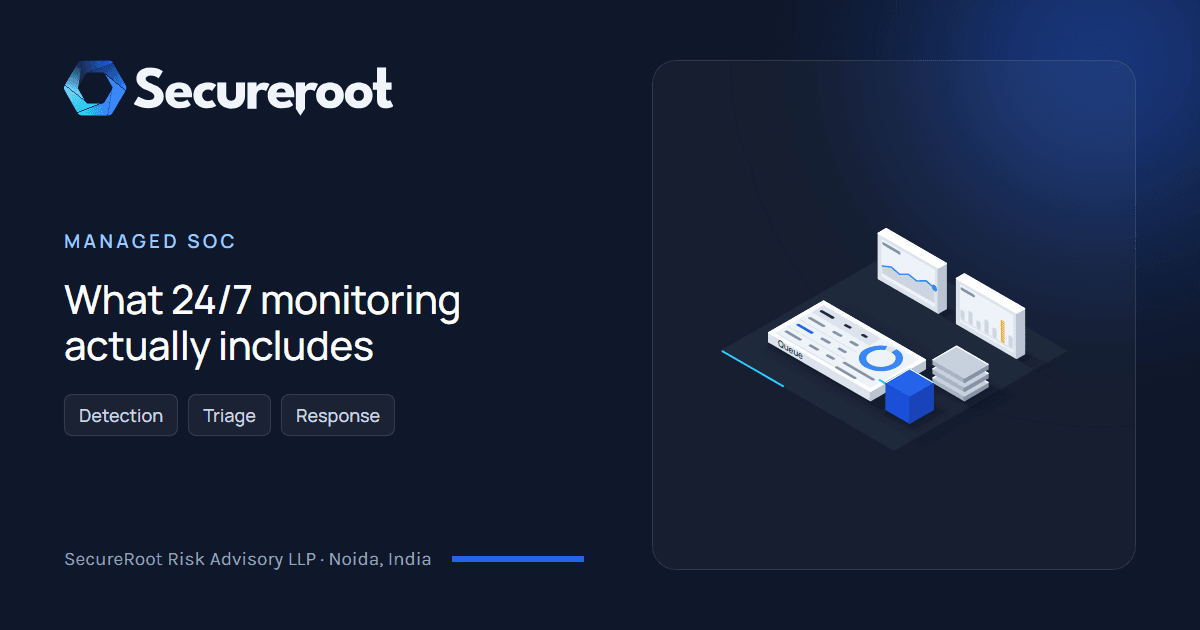
A managed SOC, or SOC as a service, is a security operations centre run by a provider's analysts: they collect logs from across your estate, tune detections to your environment, watch the alerts around the clock, investigate the ones that matter, respond when something is confirmed and report on all of it monthly. The phrase "24/7 monitoring" on its own does not tell you which of those six things you are buying. This guide sets out what each one involves, how a managed SOC compares with building one, and what to ask a provider before you sign.
The six things a managed SOC should include
The service SecureRoot runs is built from six components, and the table below is the shortest honest answer to "what does 24/7 monitoring include". Each is expanded in the sections that follow.
| Component | What it involves | When |
|---|---|---|
| Onboarding and log sources | Connect endpoints, servers, cloud and network; baseline normal activity; agree severity levels and escalation contacts; set retention | First 30 days |
| Detection tuning | Tune rules against MITRE ATT&CK coverage, suppress known-good noise, write custom rules, validate each with simulated attacks | 2 to 4 weeks |
| 24/7 monitoring and triage | Every alert triaged against the severity matrix, enriched with threat intelligence and asset context, escalated only when it needs you | Ongoing |
| Threat hunting | Hypothesis-driven searches through historical telemetry for what alerts missed; successful hunts become permanent detections | Monthly |
| Incident response | Isolate hosts, revoke credentials, run the agreed playbook with your team, preserve evidence, confirm the attacker is out | Ongoing |
| Monthly reporting | Alert volume, confirmed incidents, detection and response times against targets, ATT&CK coverage gained, next recommendations | Monthly, with a quarterly review |
Onboarding: the first 30 days decide the next 12 months
A SOC can only see what it is fed, so onboarding is where the service is made or broken. We connect log sources from your endpoints, servers, cloud and network to the monitoring platform and validate the parsing for each one, because a source that is connected but not parsed correctly generates either silence or noise. We baseline what normal looks like across users, servers and cloud accounts, so that the detections in the next phase have something to compare against.
Two agreements are made in this phase that shape everything after it. The first is the severity matrix and the escalation contacts: what counts as critical, high, medium and low for your business, and who is called for each. The second is log retention, which we set to match your compliance obligations rather than the platform's default. The output is an onboarding runbook and a log source inventory, and the inventory is worth asking any provider for, because it is the document that says exactly what is and is not being watched.
Detection tuning: fewer alerts, more of them real
Out-of-the-box detection rules are written for every environment, which means they fit none. Detection tuning is the two to four weeks in which the ruleset is made to fit yours. We tune detections against MITRE ATT&CK coverage, so the rules map to the techniques attackers actually use rather than to a vendor's catalogue. We suppress known-good behaviour that generates repeat noise, write custom rules for your business-specific applications, and validate each rule with simulated attack activity so that a detection is known to fire before it is relied on.
This phase matters to you because of response time. A SOC drowning in false positives responds slowly to the alerts that are real. A tuned ruleset is what makes the response targets in the next section achievable.
24/7 monitoring and triage: what happens to an alert
Every alert is triaged by an analyst against the agreed severity matrix. It is enriched with threat intelligence and with asset context, so that the analyst knows whether the host is a developer laptop or a production database before deciding what to do. It is then confirmed or dismissed, and escalated to your named contacts only when it needs your attention. Time to detect and time to respond are tracked for every case, and the triage log with those times is one of the deliverables.
The distinction to look for in any managed SOC proposal is between forwarding alerts and triaging them. A service that sends you every alert has moved the work rather than done it. A service that sends you confirmed threats with a recommended next step has done the work, and the monthly report should show the ratio between alerts received and incidents escalated.
We agree response targets up front, by severity. Critical events get immediate attention, and every confirmed incident comes with a clear next step rather than a notification.
Threat hunting: looking for what the rules missed
Detection rules find what they were written to find. Threat hunting is the monthly, proactive search for attackers who slipped past them. Analysts form hunt hypotheses from current threat intelligence, search historical telemetry for matching behaviour, and investigate anomalies in the places attackers most often show up, authentication and outbound traffic among them. A successful hunt is converted into a permanent detection, so the ruleset improves every month rather than only at onboarding. The output is a threat hunt findings report; its absence from a proposal is a sign the service is monitoring rather than operating.
Incident response: who does what when something is confirmed
When an incident is confirmed, our analysts lead the technical response and guide your team through containment and recovery, following an incident response playbook agreed with you before go-live. That means isolating affected hosts and revoking compromised credentials, running the agreed playbook with your technical team, preserving evidence for later forensic review, and guiding recovery through to confirming the attacker is out. Every confirmed incident produces an incident report with root cause.
The playbook being agreed in advance is the point. Deciding who can isolate a production server, and who has to be told first, is not a conversation to have during the incident. The methodology follows NIST SP 800-61, the SANS incident handling process and ISO 27035, which are the references your auditors and customers will recognise when they ask how incidents are handled.
Monthly reporting and the quarterly review
The monthly SOC report covers what we saw, what we stopped, how fast we acted and where risk can be reduced further: alert volume, confirmed incidents and their outcomes, detection and response times against the agreed targets, ATT&CK coverage gained and the gaps remaining, and the recommended next changes. A quarterly review works through the recommendations with you. This is the material that goes to a board or an auditor, and it is what turns a monitoring service into evidence that monitoring happens.
Managed SOC or your own?
The honest comparison is about what you have to hold in-house to run a SOC yourself: a platform, a tuned ruleset that someone maintains, analysts across enough shifts to cover every hour of every week, people who can hunt and people who can respond, and the discipline to report on it monthly. A managed SOC is the way to have all of it without hiring and holding every skill, in the same way that a virtual CISO provides security leadership without a full-time executive.
Two points are often missed. A managed SOC does not require replacing the tools you already run: we work with what you have where we can and only recommend additions where there is a real gap in visibility. And a SOC is a detection and response capability, not a substitute for finding and fixing vulnerabilities; it sits alongside a testing programme rather than replacing one. The red team vs penetration testing guide explains the other side of that pairing, and a red team engagement is the most direct way to test whether the SOC detects a determined attacker.
What it costs, and what sets the price
There is no list price for a managed SOC, because the effort follows the estate: how many endpoints, servers, cloud accounts and network devices are connected, how many log sources need parsing and tuning, what retention your compliance obligations require, and what response targets are agreed. Those are the inputs the onboarding phase enumerates, and they are what a scoping call establishes. You leave that call with a written scope, a timeline and a fixed price.
Where SecureRoot fits
SecureRoot's SOC as a service delivers the six components above, run on platforms including Splunk, Elastic, Wazuh and Microsoft Sentinel, with TheHive for case management, MISP for threat intelligence and Velociraptor for investigation, and measured against MITRE ATT&CK and D3FEND.
Frequently asked questions
What does a managed SOC include?
Six things, if it is a complete service: onboarding, in which log sources across endpoints, servers, cloud and network are connected and normal activity is baselined; detection tuning, in which the ruleset is fitted to your environment and validated with simulated attacks; 24/7 monitoring and triage, in which analysts confirm or dismiss every alert and escalate only what needs you; monthly threat hunting for what the rules missed; incident response under a playbook agreed before go-live; and monthly reporting with a quarterly review. A proposal that offers "24/7 monitoring" without the tuning, hunting and response components is an alert-forwarding service, and the way to tell is to ask for the log source inventory, the severity matrix and a sample monthly report. All three should exist before the first alert is handled. The monthly report is where you check that this is really happening: it should show ATT&CK coverage gained, the gaps still open, and the ratio between alerts received and incidents escalated.
How quickly does a managed SOC respond to a threat?
Response targets are agreed with you up front, by severity, before the service goes live. Critical events get immediate attention; lower severities have longer targets that suit how much attention they warrant. Every alert is triaged against that matrix, and time to detect and time to respond are recorded for every case, so the monthly report shows actual performance against the agreed targets rather than a general assurance. The thing that makes fast response possible is the detection tuning done at onboarding: an untuned ruleset produces a volume of false positives that slows the response to everything, so the two to four weeks spent tuning are what the response targets rest on. Every confirmed incident is escalated with a clear next step, not just a notification. The severity matrix itself is agreed during onboarding, together with the named escalation contact for each level, so that critical means what it means for your business rather than what a vendor's default catalogue decided.
Do we need to replace our existing security tools?
No. We work with the tools you already have where we can, and only recommend additions when there is a real gap in visibility. The monitoring platforms we operate include Splunk, Elastic, Wazuh and Microsoft Sentinel, and onboarding connects the log sources you already generate, from endpoint agents and server logs to cloud audit trails and network telemetry, rather than requiring new ones. What onboarding does insist on is that each source is validated: a source that is connected but not parsed correctly produces either silence or noise, and both are worse than knowing the source is not covered. The log source inventory produced at the end of onboarding records exactly what is watched, so a gap in visibility is a known gap rather than a surprise during an incident. Retention is set in the same phase, to match your compliance obligations rather than the platform's default, and any tooling we add sits on our side: TheHive for case management, MISP for threat intelligence, Velociraptor for investigation.
Who handles incident response when something is confirmed?
Our analysts lead the technical response and guide your team through containment and recovery, following a playbook agreed with you before go-live. In practice that means isolating affected hosts and revoking compromised credentials, running the agreed steps with your technical team, preserving evidence for later forensic review, and guiding recovery through to confirming the attacker is out. Every confirmed incident produces an incident report with root cause. The playbook being agreed in advance matters more than any tool: who is authorised to isolate a production system, who is told first and in what order, and what evidence must be preserved are decisions to make calmly, not during the incident. The methodology follows NIST SP 800-61, the SANS incident handling process and ISO 27035. Those three references are the ones your auditors and your customers recognise when they ask how incidents are handled, and the incident report with root cause is the artefact that answers them. A quarterly review then works through what the incident changed.
Is a managed SOC a replacement for penetration testing?
No, and the two answer different questions. Penetration testing finds and proves the vulnerabilities in a defined scope so they can be fixed; a SOC detects and responds to attacks against the environment as it is, vulnerabilities included. An organisation with a SOC but no testing programme is watching for exploitation of flaws it could have removed, and one with testing but no SOC has no way of knowing whether an attacker got in through something the test did not cover. They belong together. The most direct way to test a SOC is a red team engagement, which simulates a determined attacker pursuing a goal and shows whether detection and response actually work, and threat hunting inside the SOC converts what such an exercise reveals into permanent detections. The testing side is manual and exploit-driven, with a proof of concept for every finding and the retest included in the engagement, so what the SOC is measured against is a proven attack path, not scanner output.
Next step
If you are comparing managed SOC proposals, or deciding whether to build your own, book a 30 minute scoping call. Bring your log sources and your compliance obligations; you will leave with a written scope, a timeline and a fixed price, and an honest answer if what you need is smaller than a full SOC.
Have a Question About This?
If this raised something specific to your environment, a scoping call is the fastest way to get a direct answer.
We reply within one business day.