
VAPT सेवाएँ
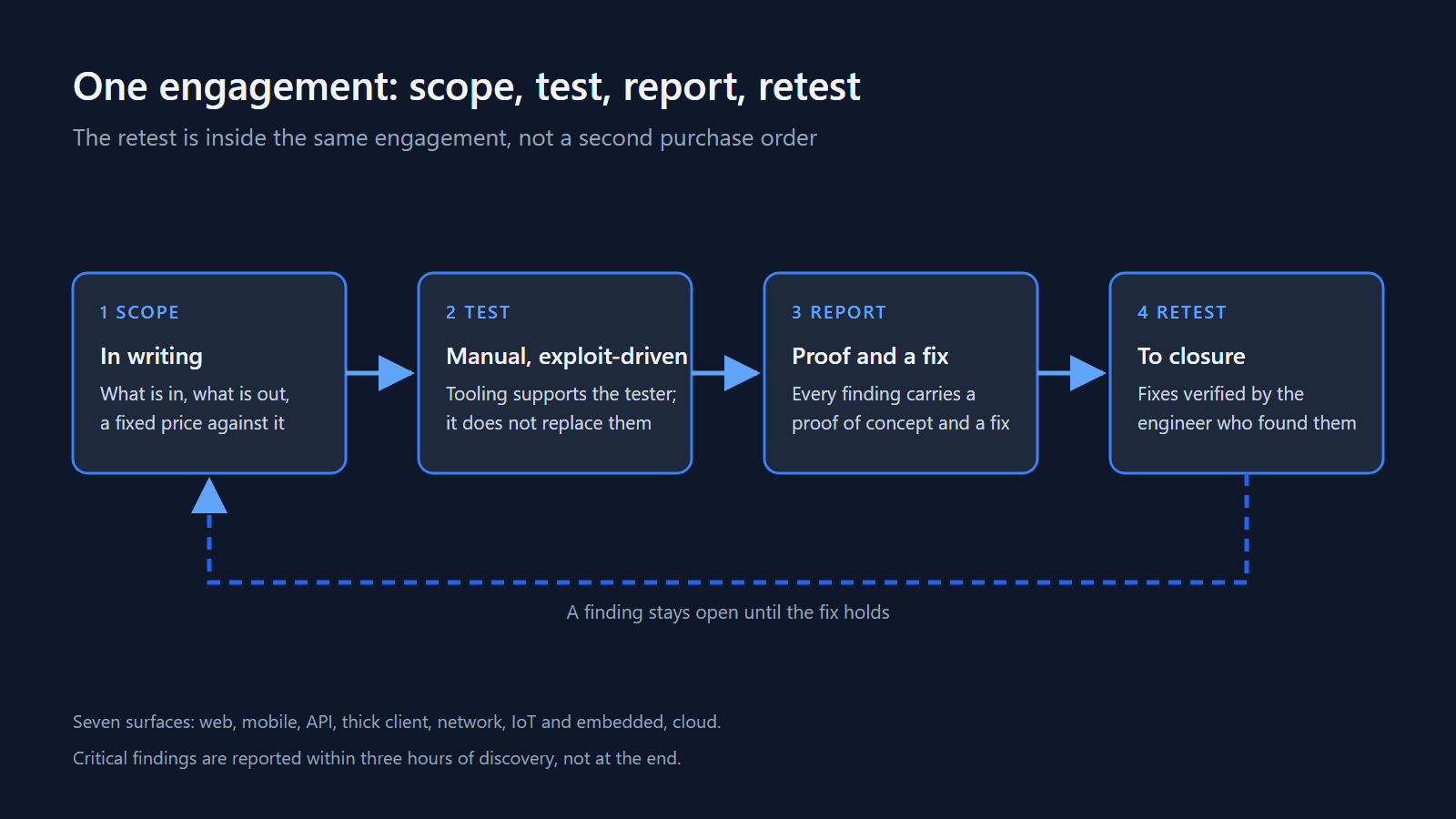
हम वैसे ही परीक्षण करते हैं जैसे कोई वास्तविक हमलावर करता, हाथ से और इरादे के साथ, न कि आपको स्कैनर का प्रिंटआउट थमा कर। आपको प्रमाणित निष्कर्ष मिलते हैं, उनके नुकसान के क्रम में, स्पष्ट सुधार और एक रीटेस्ट के साथ जो बंद होने की पुष्टि करता है।
Certified ISO/IEC 27001:2022 (certificate IN60432E)
हम कैसे काम करते हैं
SecureRoot Risk Advisory LLP का VAPT लोगों द्वारा संचालित कार्य है जिसे अच्छे उपकरणों का सहारा है। हम आपके साथ दायरा कसकर तय करते हैं, हमले की सतह का मानचित्रण करते हैं, फिर उन खामियों का पीछा करते हैं जो वास्तव में शृंखलाबद्ध होकर प्रभाव तक पहुँचती हैं, वेब और मोबाइल एप्लिकेशन से लेकर API, थिक क्लाइंट, नेटवर्क, IoT उपकरण और क्लाउड खातों तक। हर निष्कर्ष के साथ प्रूफ़ ऑफ़ कॉन्सेप्ट, व्यावसायिक भाषा में स्पष्टीकरण और स्पष्ट सुधार मार्गदर्शन होता है, और हम सुधारों का रीटेस्ट करते हैं ताकि आप उनकी मज़बूती दिखा सकें।
7 सेवाओं पर जाएंKey facts
VAPT at a Glance
- Surfaces
- Seven: web applications, mobile applications on Android and iOS, APIs, thick clients, network infrastructure (external and internal), IoT and embedded devices, and cloud accounts.
- Methodology
- Manual, exploit-driven testing. The OWASP Web Security Testing Guide for web, the OWASP MASVS for mobile and the OWASP API Security Top 10 for APIs. Tooling widens coverage rather than replacing judgement.
- Price per surface
- ₹50,000 to ₹4 lakh ($500 to $4,200) for a web, mobile, API or network test, retest included; the figure is fixed in writing after scoping.
- Duration
- Most web or API assessments run one to three weeks, plus a retest window once your fixes are in.
- Critical findings
- Reach you within three hours of discovery, before the report.
- What you receive
- A findings report with a proof of concept for every issue, an executive summary, remediation guidance, a verified retest report and an attestation letter.
- What we are not
- Not a CERT-In empanelled auditing organisation. Where a regulator or tender requires an empanelled signature on the formal report, that auditor signs it. We do the testing, fixing and retesting that decides how the audit goes.
- Before you sign
- A named engagement lead, a redacted sample report and, where a comparable client agrees to it, a reference call: all available on request, none of it published.
Reviewed by Sachin Shirish, Director, CEH (EC-Council), ISO 27001 Lead Auditor
Reviewed by Pragya Dwivedi, Associate Director, CISM (ISACA), eWPTX (INE Security)
In short
How much does VAPT cost in India, how long does it take, and who signs the report?
SecureRoot Risk Advisory LLP prices a web application, mobile application, API or network penetration test at ₹50,000 to ₹4 lakh. That is $500 to $4,200 in US dollars, retest included. Where an engagement lands in that range depends on scope, such as the number of roles, features and endpoints in a web application. The price is fixed in writing after scoping, never before. Most web or API assessments run one to three weeks, plus a retest window once your fixes are in. Critical findings reach you within three hours of discovery, before the report. The testing is manual and exploit-driven, and every finding carries a proof of concept and remediation guidance. SecureRoot is not a CERT-In empanelled auditing organisation. Where a regulator or tender requires an empanelled signature on the formal report, that auditor signs it. We do the testing, fixing and retesting that decides how the audit goes.
Seven surfaces
Indicative Bands by Surface
| Surface | Indicative band | US dollars | Retest |
|---|---|---|---|
| Web Application | ₹50,000 to ₹4 lakh | $500 to $4,200 | Included |
| Mobile Application | ₹50,000 to ₹4 lakh | $500 to $4,200 | Included |
| API | ₹50,000 to ₹4 lakh | $500 to $4,200 | Included |
| Thick Client Application | Scoped, then quoted in writing | Included | |
| Network Infrastructure | ₹50,000 to ₹4 lakh | $500 to $4,200 | Included |
| IoT and Embedded | Scoped, then quoted in writing | Included | |
| Cloud | Scoped, then quoted in writing | Included |
Per surface, with the retest inside the engagement. Three surfaces are scoped before quoting because their spread is too wide for a band to help.
Who signs
Who May Test and Sign Your Report
| Regulator or buyer | Who may test | CERT-In empanelment required? |
|---|---|---|
| SEBI | A CERT-In empanelled information security auditing organisation for audits and VAPT, unless the framework says otherwise. Self-certification entities are included for VAPT | Yes |
| IRDAI | A CERT-In empanelled auditor, for vulnerability assessment, external testing and internal VAPT alike | Yes |
| RBI | “Independent information security experts or auditors” | Not stated |
| PCI SSC | A “qualified tester with organisational independence”; an Approved Scanning Vendor for quarterly external scans (11.3.2) | No. The ASV rule covers scans only |
| CERT-In | Not specified | No |
| Government and PSU tenders; NCIIPC-identified critical infrastructure | Usually a CERT-In empanelled auditor, named in the tender | Usually yes. Read the tender |
SecureRoot Risk Advisory LLP is not CERT-In empanelled. Where the SEBI row or a tender names the panel, we run the testing and the retest, and the empanelled auditor signs the formal report.
VAPT की सेवाएं
7 सतहों पर मैनुअल, शोषण-आधारित पेनिट्रेशन टेस्टिंग
इस सेवा क्षेत्र में 7 सेवाएं
- 01Web ApplicationManual testing of your web apps against the OWASP WSTG
- 02Mobile ApplicationAndroid and iOS app testing against the OWASP MASVS
- 03APIREST, GraphQL and SOAP testing against the OWASP API Top 10
- 04Thick Client ApplicationDesktop app testing across binary, traffic and backend
- 05Network InfrastructureExternal and internal network testing with lateral movement
- 06IoT and EmbeddedDevice testing across firmware, hardware and radio
- 07CloudConfiguration and IAM testing across AWS, Azure and GCP
किन मानकों पर आंका जाता है
PTESCVSS v4.0NIST SP 800-115OWASPWSTGOWASPASVSOWASPAPI Top 10OSSTMMISECOMCISBenchmarks

हम किन उपकरणों से काम करते हैं
Burp Suite ProfessionalNucleiGhidraWiresharkffufNmapFridaOWASP ZAP




जो मिलता है, उसे हम किस क्रम में रखते हैं
परीक्षण चाहे किसी भी सतह को कवर करे, निष्कर्ष एक ही कतार में आते हैं और इस आधार पर क्रम में रखे जाते हैं कि उनका वास्तविक हमलों में उपयोग हो रहा है या नहीं।
उदाहरण
A vulnerability management product view. Illustrative snapshot of a typical programme, not a named client. Headline figures for the quarter across 1,340 in-scope assets and 40 web applications: 4,812 open findings, of which 288 are past their internal SLA; 37 critical findings open; blended mean time to remediate 84 days, computed from the 3,371 closures this quarter, 24 critical at 21 days each, 391 high at 38, 2,100 medium at 74 and 856 low at 130, which is 282,042 finding-days over 3,371 closures; SLA compliance 68 percent, 2,292 of 3,371 closures within SLA. Open findings by CVSS v3.1 band: Critical 37, which is 0.8 percent; High 412, 8.6 percent; Medium 1,954, 40.6 percent; Low 2,409, 50.1 percent. A further 1,106 informational findings are excluded from that total. 19 open findings are listed on the CISA Known Exploited Vulnerabilities catalogue and 4 of those are past their CISA BOD 22-01 due date. Findings over 13 weeks: 2,993 new against 3,371 remediated, so the open backlog fell from 5,190 to 4,812, with a spike of 402 new findings in week 6 when the quarterly authenticated scan ran. Mean time to remediate by severity against target: Critical 21 days against a 15-day target, High 38 against 30, Medium 74 against 90, Low 130 against 180. The table lists 13 representative findings ranked by exploitability, led by CVE-2024-3400, GlobalProtect OS command injection, CVSS 10.0, EPSS 0.944, on KEV, 13 days old and open; CVE-2023-4966, NetScaler session token leak, CVSS 9.4, on KEV, 41 days old and in progress; and CVE-2021-44228, Log4j2 JNDI remote code execution on a legacy build host, CVSS 10.0, on KEV, 402 days old and still open.
4,812
Open
288 past SLA
37
Critical
19 on KEV
84d
MTTR
3,371 closed
68%
Within SLA
2,292 of 3,371
By Severity, 4,812 Open
19 on CISA KEV, 4 past their CISA due date.
Illustrative snapshot of a typical programme, not a named client.
इनमें से हर एक का स्कोप, संचालन और रिपोर्टिंग वही एक टीम करती है। सभी सेवा क्षेत्र देखें
Credentials
What We Hold, and What It Covers
What the Firm Holds
- ISO/IEC 27001:2022
- Certificate IN60432E, certification body Staunchly Management & System Services Private Limited
- SecureRoot's own information security management system is certified. It is a certificate about how we run our firm, not a certificate for your systems, and working with us does not confer it on you.
- ISO 9001:2015
- Certified quality management system
- SecureRoot's own quality management system is certified. Like the certificate above, it is about the firm itself and is not an assessment of any client.
Not CERT-In Empanelled
SecureRoot is not a CERT-In empanelled auditing organisation, and we will not blur that line. If your regulator or a tender requires the formal VAPT report to be signed by an empanelled auditor, that auditor signs it.
What we do is the work that decides how that audit goes: we test the same systems earlier and by hand, prove which findings are real, help your developers fix them, and retest until they are closed.
Case study
A Lending Platform Closes Critical Application Risk Before Scale-up
- 27 Findings Fixed
- 100% Criticals Closed
- 9 days Mean Time to Fix
What It Costs
Indicative Ranges, Before You Ask
Every figure below is an indicative range, not a quote. Where you land in it depends on scope, and we confirm a fixed price only once scoping is done.
- Indicative rangeDepends on scope
Web, mobile, API or network VAPT, per surface
₹50,000 to ₹4 lakh, retest included
Range as of 2 September 2026
$500 to $4,200
US dollar range as of 2 October 2026
What sets the figure
- Manual, exploit-driven testing of one surface: a web application, a mobile application, an API or a network
- The size of that surface (user roles and endpoints, platforms, hosts and segments) sets where you land in the range
- Proof of concept for every finding, a report with fixes, and a retest once you remediate
Indicative ranges in INR, with a US dollar range where one is shown; the final quote depends on scope, and each range is dated on its own card.
Every band, third-party fees separate, is on the pricing page.
Get a Fixed Price for Your Scope
Tell us what is in scope and when you need it. You get a written scope and a fixed price, not a band.
Sample Report
Request a Sample Report
See what a SecureRoot VAPT report looks like before you buy: a redacted report from a delivered engagement, findings, evidence and remediation included. It is not published; a consultant emails it on request. Tell us where to send it.
One form, the same notice as every enquiry on this site.
What does a VAPT with SecureRoot actually cover?
Seven surfaces: web applications, mobile applications on Android and iOS, APIs, thick clients, network infrastructure (external and internal), IoT and embedded devices, and cloud accounts on AWS, Azure, GCP, DigitalOcean and Oracle Cloud. Web applications are tested against the OWASP Web Security Testing Guide, mobile applications against the OWASP MASVS and APIs against the OWASP API Security Top 10. Each is a separate service with its own scope, methodology and pricing band, and you can combine them in one engagement. The work is manual and exploit-driven. SecureRoot's engineers test by hand, the way an attacker would, and use tooling to widen coverage rather than to replace judgement. Every finding we report has been proven with a proof of concept. It is explained in business language, ranked by the damage it does and comes with clear remediation. A retest is part of the engagement, so you can show the fix held.
How do we start, and what happens on the scoping call?
One scoping call, usually 30 to 45 minutes, with the people who will do the work. Bring the deadline, the auditor's question or the customer questionnaire that started this, and tell us what you run. SecureRoot maps the surfaces that matter against what is urgent and agrees the targets, environments, roles and any off-limits actions. Then we send you a written scope, a timeline and a fixed price. The price is fixed after scoping, never before, and it does not grow later as an open-ended estimate would. If we are not the right fit for the problem, we say so on the call. Once the scope is signed, we set testing windows and escalation contacts so nothing takes your team by surprise. The engagement starts from a Rules of Engagement document both sides have agreed in writing.
How long does a VAPT take?
Most web or API assessments run one to three weeks depending on scope, plus a retest window once your fixes are in. A single web application usually takes one to two weeks, driven by the number of roles, features and endpoints we test by hand. A mobile application depends on whether Android, iOS or both are in scope and how large the backend behind the app is. A network test depends on whether it is external, internal or both and how many hosts and segments it covers. SecureRoot confirms the timeline once scoping is done. You do not wait for the report to hear bad news. Critical findings reach you within three hours of discovery. Your team can start on the fix while the rest of the test continues to its agreed end date.
What does a VAPT cost?
Indicative range: ₹50,000 to ₹4 lakh, or $500 to $4,200 in US dollars, retest included, for a web application, mobile application, API or network penetration test. Where an engagement lands in that range depends on scope. For a web application it is mainly the number of roles, features and endpoints. For a mobile application, whether we test Android, iOS or both and the size of the backend. For an API, how many endpoints, tenants and authentication schemes we cover. For a network, whether the test is external, internal or both and how many hosts and segments it spans. These are ranges, not quotes. SecureRoot confirms a fixed price once scoping is done. That price includes the retest, so there is no separate invoice for verifying your fixes. The indicative ranges are reviewed and stated in INR on each service page.
Do you help with the fixes, and is the retest included?
Yes to both. Every finding carries specific remediation guidance. The engineer who found the flaw is the one who explains the fix to your developer, in your language and your codebase. SecureRoot engineers are available to yours during fix sprints. When you tell us the fixes are in, we retest each finding and confirm whether it is genuinely closed. The retest is part of the engagement, not a separate invoice, and it produces a verified retest report you can hand to an auditor or a customer. A closed finding means fixed and retested, not acknowledged. If a fix does not hold, the finding stays open and we tell you why. The report you finally rely on then reflects what an attacker would actually find today, not what was promised at the end of the first round.
Can the report be used as evidence for a SOC 2, ISO 27001 or DPDP Act audit?
That is a common reason clients come to us, and the deliverables are built for it. You receive a findings report with proof of concept for every issue, an executive summary, remediation guidance, a verified retest report and an attestation letter. The evidence trail runs from discovery to confirmed closure. The same team scopes ISO 27001, SOC 2 and DPDP Act programmes and the manual VAPT engagements that test them. The test can then be timed to your audit window and scoped to the systems the auditor will ask about. SecureRoot itself holds ISO/IEC 27001:2022 certificate IN60432E. If you need the compliance side as well, the SOC 2, ISO 27001 and DPDP Act services linked below are run by the same people. They work from one control set and one evidence base, on a single timeline.
Can we see a sample report or speak to the lead before we sign?
Yes, on request, and before anything is signed. SecureRoot will name the engagement lead who will run your test and put them on the scoping call, not an account manager. We will send a redacted sample report. With it you can judge the depth of a finding, the evidence behind it and the remediation guidance against what you are paying for. A reference is the one thing we ask for rather than promise. We go to the client whose work most resembles yours and ask whether they will take a call. No name is passed on before they have said yes. Where nobody is available we offer a walkthrough of a delivered engagement with the identifying details removed. None of this is published here, because our clients decide what is said about their work. That is also why the case studies on this site carry no names.
Primary Sources
Where the Figures on This Page Come From
Figures and requirements above are taken from the sources below, linked to the primary text wherever one exists rather than to a summary of it.
- OWASP Web Security Testing Guide (WSTG)
OWASP Foundation · Link checked 2026-11-03
- OWASP Mobile Application Security Verification Standard (MASVS)
OWASP Foundation · Link checked 2026-11-03
- OWASP API Security Top 10
OWASP Foundation · Link checked 2026-11-03
- NIST SP 800-115 - Technical Guide to Information Security Testing and Assessment
National Institute of Standards and Technology (CSRC) · Link checked 2026-11-03
- Penetration Testing Execution Standard (PTES)
PTES project, on Read the Docs · Link checked 2026-11-03
तय नहीं कर पा रहे कि इनमें से क्या चाहिए?
हमें बताइए कि आपसे क्या प्रमाणित करने को कहा गया है, या आपको किस बात की चिंता है। हम आपको सही काम की ओर ले जाएंगे, भले ही वह आपकी अपेक्षा से छोटा निकले।
Related Reading
Articles on VAPT
- Types of Penetration Testing: Black, Grey and White Box
- VAPT and Penetration Testing Cost in India: 2026 Pricing Guide
- OWASP Top 10 Vulnerabilities Explained (With Fixes)
- Red Team vs Penetration Testing: Key Differences Explained
- CERT-In Directions Compliance in India: Logs, NTP, Reporting and Records
- CERT-In Incident Reporting: The Six-Hour Runbook
- How Often Should VAPT Be Done? Annual Baseline, Change Triggers and Regulator Cadence in India
- SEBI CSCRF Compliance Guide: Categories, Audits, VAPT and SOC
Related Pages
Built for a Specific Buyer
- VAPT for Banks, NBFCs and Fintechs in IndiaFinancial Services
- PCI DSS Penetration TestingCompliance Testing
- PCI DSS for Payment Aggregators and FintechsPayments and Fintech
- SOC 2 Penetration TestingCompliance Testing
- ISO 27001 Penetration TestingCompliance Testing
- DPDP Act Security Testing and VAPTCompliance Testing
Related Compliance
Testing for an Audit? Start Here
- SOC 2If the test is evidence for a Type 1 or Type 2 report, the same team builds the control set it supports.
- ISO 27001For an ISMS audit, we scope the test to the systems the auditor will ask about and time it to your audit window.
- DPDP ActIf personal data is in scope, DPDP Act readiness and the testing of the systems that hold it run as one programme.
Related Services
Often Scoped Alongside This
Read First
Before You Shortlist Anyone
- How to Choose a VAPT Company in IndiaNine criteria for reading a proposal, including who may sign the report you are being sold.
- Penetration Testing for Regulated Firms in GurugramWhat the RBI, IRDAI and PCI DSS each ask a test to prove, and where empanelment binds.
- Who Can Sign Your Security ReportThe four signatures a buyer may want, and who can give each.
- How to Scope a Web Application and API Penetration TestThe decisions that set the effort: roles, tenants, API definitions, environments and exclusions.
- Understanding Pentest Findings and RetestingHow to read the report: CVSS v4.0 grade, business impact, proof of concept, and how the retest closes a finding.
अन्यत्र
अन्य सेवा क्षेत्र
- अनुपालन13 फ़्रेमवर्क में प्रमाणन और गोपनीयता कार्यक्रम
- Secure Code Review (SCR)आपके सबसे संवेदनशील कोड पथों की मैनुअल, पंक्ति दर पंक्ति समीक्षा, SAST छँटाई के साथ।
- Software Composition Analysis (SCA)जानिए कि आप कौन सी तृतीय-पक्ष और ओपन सोर्स निर्भरताएँ भेजते हैं, और उनके साथ कौन सा जोखिम आता है।
- हार्डनिंग और कॉन्फ़िगरेशन समीक्षाक्लाउड, ऑपरेटिंग सिस्टम, नेटवर्क और डेटा स्तर पर बेंचमार्क-आधारित कॉन्फ़िगरेशन हार्डनिंग
- प्रबंधित सेवाएँहमारी टीम द्वारा संचालित निरंतर आक्रामक, रक्षात्मक और परामर्श सुरक्षा